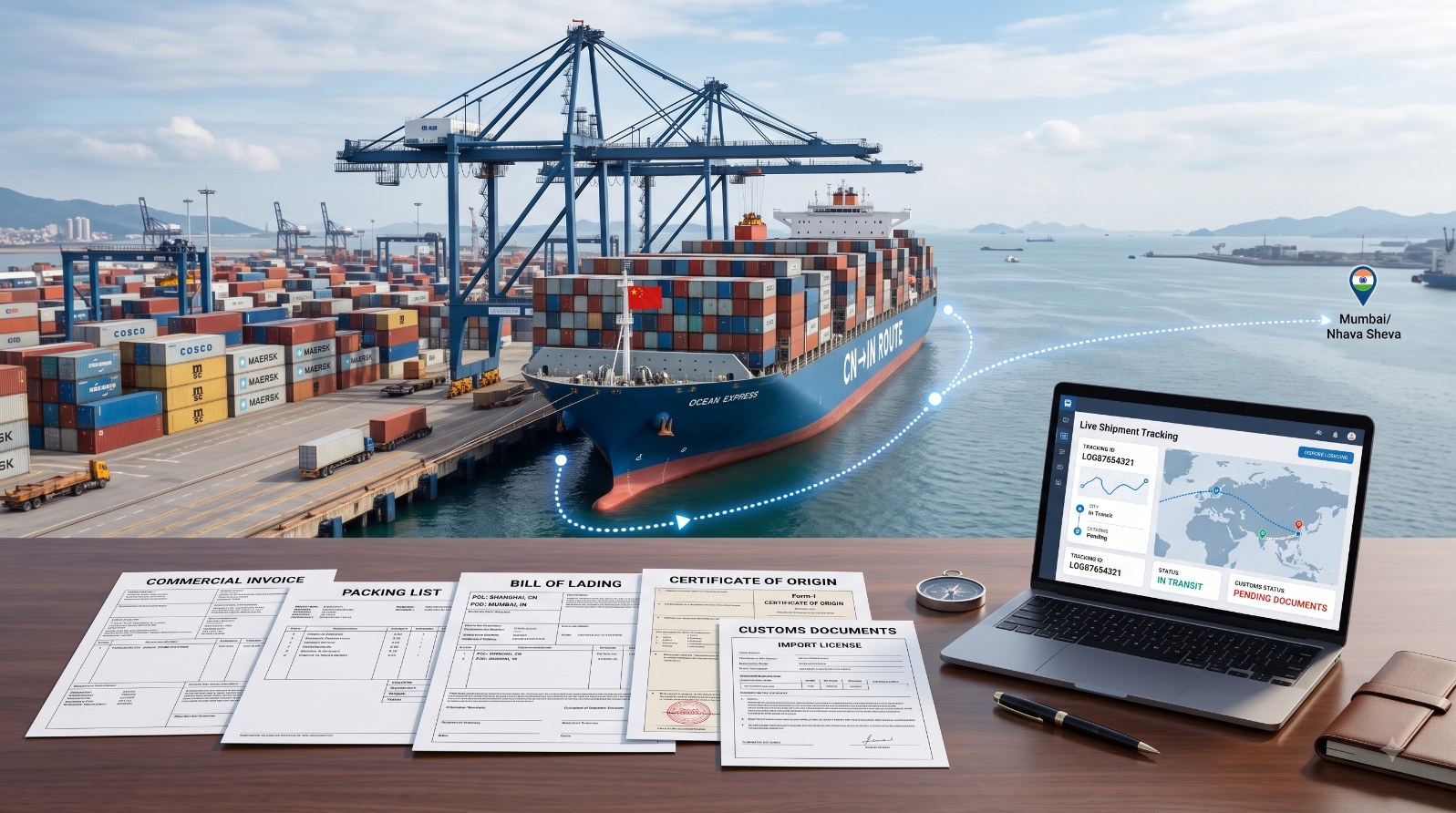
(And why, if you work with Pree Import Export Co., you don't need to worry about a single one of them.)
If you've ever looked into importing from China, you've probably run into a wall of paperwork jargon — IEC, ICEGATE, Bill of Entry, Certificate of Origin, BIS certification. It's enough to make a first-time importer give up before they've placed a single order.
Here's the truth: importing from China to India is a documentation-heavy process. Indian Customs, DGFT, and product regulators all require specific paperwork at different stages of the journey — and getting even one piece wrong can mean your shipment sits at the port racking up demurrage charges while you scramble to fix it.
This guide breaks down exactly what's required, stage by stage, so you understand the process. Then we'll show you how Pree removes all of it from your plate.
1. Business Registrations You Need Before You Place an Order
These aren't shipment documents — they're the legal groundwork that has to be in place before your first purchase order goes out.
- Importer Exporter Code (IEC): A 10-digit code issued by the Directorate General of Foreign Trade (DGFT). Without it, no commercial import can legally clear Indian customs.
- GST Registration: Required to pay IGST at customs and to claim Input Tax Credit on that IGST later.
- ICEGATE Registration: Enables digital filing and communication with Indian Customs.
- AD Code Registration: Links your bank to customs so duty payments and refunds can be processed.
2. Documents Your China Supplier Needs to Provide
Once an order is placed, these travel with the cargo and are typically prepared on the supplier's side:
- Commercial Invoice — details the transaction: product description, value, and terms of sale.
- Packing List — a breakdown of shipment contents, quantities, and packaging specifics.
- Certificate of Origin — certifies the goods were manufactured in China, which affects applicable duties.
- Bill of Lading (sea freight) or Airway Bill (air freight) — the shipping document issued by the carrier.
- Insurance Certificate — required if the shipment is bought on CIF terms.
3. Documents Needed for Customs Clearance in India
These are filed at the India end, usually by a Customs House Agent (CHA):
- Bill of Entry (BoE) — filed on the ICEGATE portal, declaring product details, HS codes, and assessable value.
- Authorisation Letter to your CHA — permits the agent to act on your behalf.
- KYC Documents — importer identity and business verification.
Once filed, applicable Basic Customs Duty, IGST, and Social Welfare Surcharge are calculated and paid before the shipment is released.
4. Product-Specific Certifications (Where Applicable)
Depending on what you're importing, additional approvals may be mandatory:
- BIS Certification — required for many electronics, toys, and industrial goods.
- FSSAI Approval — for food and food-contact products.
- CDSCO Clearance — for medical devices and pharmaceuticals.
- WPC Approval — for wireless and telecom equipment.
- LMPC Compliance — packaging and labelling rules (MRP declarations, unit weights, etc.) under the Legal Metrology Act.
- EPR Registration — for plastic packaging and e-waste-generating products.
Missing a product-specific certificate is one of the most common reasons shipments get held at Indian ports.
So — Do You Need to Deal with Any of This Yourself?
If you're importing on your own, yes — every document above is your responsibility to arrange, verify, and file correctly.
If you're working with Pree Import Export Co.,
That's the whole point of how we operate. You don't hand us a folder of paperwork, and we don't ask you to chase suppliers for a Certificate of Origin or navigate the ICEGATE portal yourself. We run the entire import — registrations, supplier-side documentation, customs filing, and product compliance — on our own documents and our own systems. You place the order; we handle the paper trail from Shenzhen to your warehouse door.
Your trust, delivered, every time.
Have a shipment coming from China? Talk to Pree import export co. before you place the order — not after customs flags it.

