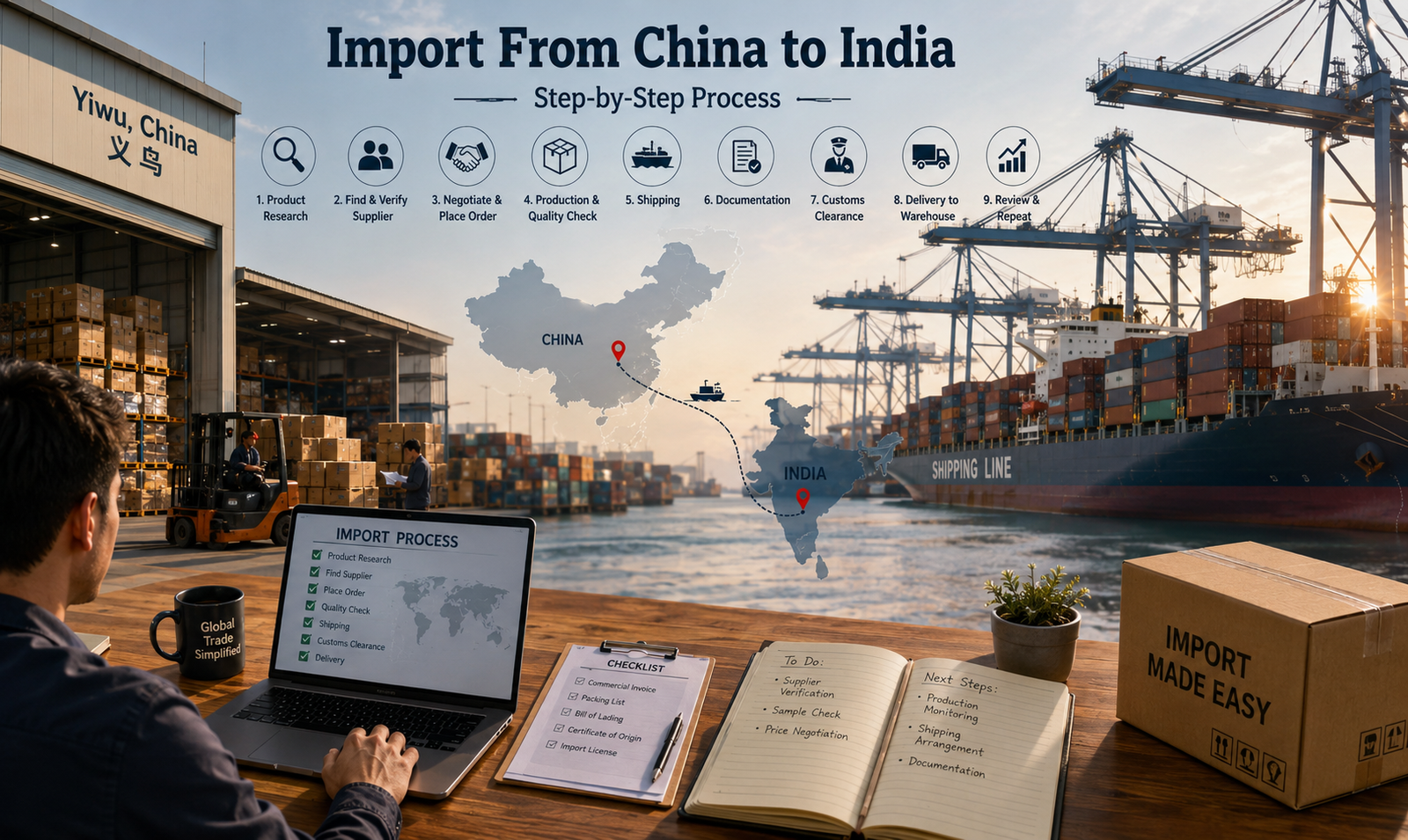
China remains the world's largest manufacturing hub, offering competitive pricing across nearly every product category — apparel, electronics, home & kitchen goods, machinery parts, toys, and more. But importing from China isn't as simple as placing an order and waiting for it to arrive. Between sourcing, negotiation, quality checks, customs clearance, and last-mile delivery, there are several steps where first-time (and even experienced) importers commonly lose time and money.
This guide breaks the process down step by step, whether you're importing your first small batch or scaling up an established supply chain.
Step 1: Identify Your Product and Research the Market
Before reaching out to any supplier, get clear on:
- What exactly you're importing — specifications, materials, size variants, and certifications required (especially for electricals, medical devices, or food-contact items)
- Demand and pricing in your target market, so you know what margin you're working with after landed costs
- Import regulations for that product category in your country — some goods require licenses, BIS certification, or specific labelling
A little research here prevents costly mistakes later, like ordering a product that gets held up at customs due to a missing certification.
Step 2: Find and Vet Reliable Suppliers
China's manufacturing base is vast, which is both an opportunity and a risk. You can find suppliers through:
- Alibaba, Made-in-China, or Global Sources for direct outreach and small-to-mid volume orders
- Trade fairs like the Canton Fair for building direct manufacturer relationships
- Sourcing agents or buying agents on the ground in China, who can visit factories, verify legitimacy, and often get better pricing than you would on your own
Whichever route you take, vet suppliers carefully — check business licenses, ask for references, and request product samples before committing to a bulk order.
Step 3: Negotiate Price, MOQ, and Terms
Once you've shortlisted suppliers, it's time to negotiate:
- Minimum Order Quantity (MOQ) — smaller orders are possible with many suppliers, but pricing improves at higher volumes
- Payment terms — a common structure is 30% deposit upfront and 70% before shipment, though this varies
- Incoterms (FOB, CIF, EXW, etc.) — these determine who's responsible for freight, insurance, and risk at each stage, and they materially affect your landed cost
Get everything in writing, including a proforma invoice that clearly states product specs, quantity, price, and delivery timeline.
Step 4: Place a Sample Order Before Bulk Production
Never skip this step, even under pressure to move fast. A sample order lets you verify:
- Actual product quality against what was promised
- Packaging and labelling
- Whether the supplier meets your delivery timelines
If the sample doesn't match expectations, it's far cheaper to walk away now than after a full container has shipped.
Step 5: Arrange Quality Inspection Before Shipping
For bulk orders, arrange a pre-shipment inspection — either through a third-party inspection agency or a sourcing partner with people on the ground. This step catches defects, wrong specifications, or short shipments before the goods leave China, when it's still possible to resolve issues with the supplier directly.
Step 6: Choose Your Shipping Method
Your two main options:
- Sea freight — most cost-effective for larger, heavier shipments, but slower (typically 35–40 days port to port depending on route)
- Air freight — faster (10-12 days) but significantly more expensive per kilogram, better suited to smaller, high-value, or time-sensitive shipments
For growing businesses, a mix of both — air for urgent restocks, sea for regular bulk orders — is common.
Step 7: Prepare Export and Import Documentation
Documentation is where many first-time importers stumble. At minimum, you'll typically need:
- Commercial invoice and packing list
- Bill of Lading (sea) or Air Waybill (air)
- Certificate of Origin
- Import license or product-specific certifications, if applicable
- Insurance documents
Errors or missing paperwork are among the most common causes of customs delays, so accuracy here matters more than speed.
Step 8: Customs Clearance
Once your shipment arrives at the port or airport, it goes through customs clearance in your country. This involves:
- Filing a Bill of Entry
- Paying applicable customs duty, IGST, and any other levies
- Passing any physical or documentary inspection customs may require
A customs broker or clearing agent familiar with your product category can significantly speed this process up and reduce the risk of penalties from classification errors.
Step 9: Warehousing and Last-Mile Delivery
After clearance, goods typically move to a warehouse for storage, sorting, or consolidation before final delivery to your business address. If you're importing regularly, having access to warehousing near major ports can save on repeated short-notice logistics costs.
Step 10: Review and Optimize for Future Orders
Once your shipment is delivered, review the full process:
- Was the landed cost in line with your projections?
- Did the supplier meet quality and timeline expectations?
- Where did delays or extra costs creep in?
Each import cycle should make the next one smoother, whether that means renegotiating terms, switching suppliers, or adjusting your shipping mix.
Final Thoughts
Importing from China can be highly profitable, but it's a process with many moving parts — sourcing, negotiation, quality control, shipping, and customs — where a single misstep can cost time and money. Whether you're bringing in your first sample order or managing regular container shipments, having an experienced partner on both the China and India sides of the process makes the difference between a smooth import and a stressful one.
Looking for a trusted partner to simplify your import journey from China? Pree Import Export Co. offers end-to-end import-export solutions — from sourcing and supplier verification to customs clearance and door-to-door delivery. Get in touch for a free consultation.

